
Accurate Insights for Stronger Legal Cases
Legally Reviewed by Robert Alden on August 7, 2026
When a serious crash happens, the facts rarely speak for themselves. Insurance companies and opposing legal teams move quickly to build a version of events that favors their side, and without hard evidence to counter that narrative, a strong case can lose ground before it ever reaches the negotiating table.
At Byrd Davis Alden & Henrichson, LLP, we understand how critical accident reconstruction evidence can be in car accident cases across Texas. As Austin’s oldest personal injury law firm, established in 1959, our Board Certified Personal Injury Trial attorneys, Robert Alden and Kevin Henrichson, have spent decades building cases backed by thorough investigation, credible expert witnesses, and an unwavering commitment to holding negligent parties accountable.
⚠ Time-Sensitive — Texas Law Limits Your Window to File
Disputed over who caused your Austin crash? Texas gives you two years from the date of the accident to file a personal injury lawsuit. After that window closes, your right to recover compensation may be gone permanently.
65+ years representing Austin accident victims. Board Certified trial attorneys. No fees unless we recover for you.
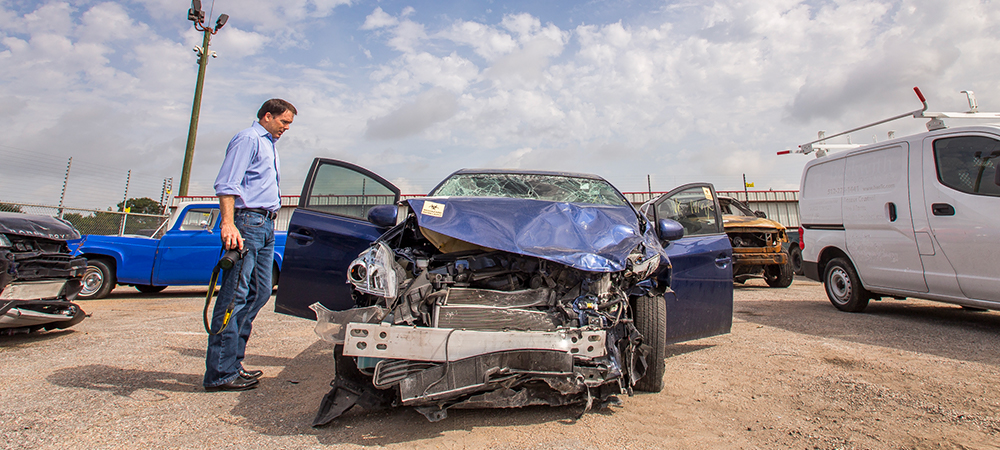
Accident reconstruction is a forensic process used to analyze the physical evidence left behind by a crash and determine how and why it occurred. Experts in this field are typically engineers or specialists trained in the physics of vehicle collisions, and they use a combination of tools and techniques to piece together the sequence of events.
Reconstruction specialists examine a wide range of evidence when building their analysis. The process is thorough and often covers details that may not seem significant at first glance. Factors commonly analyzed include the following.
Reconstruction experts synthesize all of these data points into a comprehensive report that can be introduced as evidence in your case.
Modern vehicles capture far more than they did even a few years ago. Many cars now automatically log braking data, acceleration patterns, speed, and collision timing, which means reconstruction increasingly draws on a vehicle’s own digital record rather than witness memory alone. This evidence is powerful, but it is also perishable. Onboard systems overwrite old data as part of normal vehicle operation, so the window to secure it after a crash is often measured in days.
In disputed liability cases, having an expert’s objective analysis is often the difference between a favorable settlement and a failed claim. Reconstruction evidence is particularly powerful in cases involving defective vehicle components, multi-vehicle pileups, or crashes where one party attempts to shift blame onto the victim. According to the National Highway Traffic Safety Administration, an estimated 36,640 people died in traffic crashes in 2025, and many of those crashes involved disputed facts about what happened and who was at fault. Reconstruction analysis helps cut through the confusion and establish the truth.
Not every crash requires reconstruction analysis, but in cases involving serious injuries, fatalities, or significant disputes over fault, it becomes an essential tool. Our team regularly incorporates expert reconstruction in cases involving causes of trucking wrecks in Texas, high-speed collisions, and crashes where the at-fault driver is denying responsibility.
Reconstruction is especially valuable when surveillance footage is unavailable or incomplete, when physical evidence at the scene was disturbed before being documented, or when an insurance company is attempting to minimize its policyholder’s role in the crash. A qualified expert gives your attorney the foundation to argue your case with confidence, whether at the negotiating table or in front of a jury.
An accident reconstruction expert does not simply describe what happened; they testify to it with scientific authority. Their findings can help establish the at-fault driver’s speed, demonstrate that a specific vehicle defect contributed to the crash, or show that road conditions were more dangerous than a defendant is willing to admit. This type of evidence is particularly critical in catastrophic injury cases where the stakes are high and the opposing party has significant resources to fight your claim.
Our attorneys work closely with respected accident reconstruction experts throughout Texas to ensure that every element of a case is properly documented and analyzed. We investigate early, preserve evidence before it disappears, and build a legal strategy designed to maximize your recovery. If you would also like to understand more about how a reconstructionist can directly impact your personal injury claim, our blog post on how an accident reconstructionist can support your personal injury claim goes deeper into the role these experts play.
Texas follows a modified comparative fault rule, meaning your compensation can be reduced if you are found partially at fault, and you cannot recover damages if your share of fault exceeds 50 percent. Reconstruction evidence is often what determines that percentage. A qualified expert can establish that the other driver was speeding, that a defective part failed before impact, or that road conditions contributed more to the crash than a defendant is willing to admit.
This matters directly for your damages. Texas law allows you to pursue compensation for medical expenses, lost wages, future medical costs, pain and suffering, and property damage after a serious crash, and the strength of your liability evidence often shapes how much of that compensation an insurer is willing to pay before a case ever reaches trial.
Under Texas Civil Practice and Remedies Code Section 16.003, injured victims generally have two years from the date of the crash to file a personal injury lawsuit. If a crash results in a fatality, surviving family members have two years from the date of death, not the date of the crash, to file a wrongful death claim.
Missing this deadline typically means losing your right to recover compensation permanently, no matter how strong your case may be. Reconstruction evidence is also time-sensitive well before that legal deadline arrives, since skid marks fade, surveillance footage is overwritten, and vehicle data can be lost within days of a crash. The safest step is to contact an attorney as soon as possible so nothing is left to chance.
When you are recovering from a serious crash, you need attorneys who will do the work, not just settle quickly for whatever the insurance company offers. Byrd Davis Alden & Henrichson, LLP has been fighting for injured Texans since 1959, and our reputation is built on results. We are recognized by U.S. News & World Report as one of the Best Law Firms in the U.S., listed in Super Lawyers and Best Lawyers, and our attorneys, Robert Alden and Kevin Henrichson, are both Board Certified in Personal Injury Trial Law by the Texas Board of Legal Specialization. We are not a volume firm, and we are not in the business of processing cases; we are in the business of winning them.
If accident reconstruction evidence could strengthen your case, we are ready to put our experience and expert network to work for you. Our team handles every case with the thoroughness it deserves, and we are here to answer your questions from the very first conversation. Contact us today to schedule a consultation with one of our Austin personal injury attorneys.
Not every crash requires one. Reconstruction experts are most valuable in cases involving serious injuries, fatalities, or a genuine dispute over who caused the crash. If liability is clear and undisputed, your attorney may not need to bring in a reconstruction specialist, but in contested cases this evidence can be the difference between a fair settlement and a denied claim.
Byrd Davis Alden & Henrichson, LLP handles accident reconstruction cases on a contingency fee basis, so you pay nothing upfront. Our firm covers the cost of qualified experts as part of building your case, and we only get paid if we recover compensation on your behalf.
Texas gives most personal injury victims two years from the date of the accident to file a lawsuit. Missing that deadline typically means losing the right to recover anything, regardless of how strong the case is. Reconstruction evidence in particular should be secured well before that deadline, since physical evidence and vehicle data degrade quickly.
Yes. Police reports reflect an officer's assessment at the scene, not a final determination of fault. Reconstruction experts conduct an independent analysis using physical evidence, vehicle data, and witness accounts, and their findings can directly challenge a police report that assigned you more blame than the facts support.
Reconstruction reports are built to withstand challenge. Experts document their methodology, cite the physical evidence supporting each conclusion, and can testify to their findings under oath. When a defendant disputes reconstruction evidence, your attorney can use the expert's testimony to counter competing theories at the negotiating table or in front of a jury.
We use cookies to improve your experience on our site. By using our site, you consent to cookies.
Manage your cookie preferences below:
Essential cookies enable basic functions and are necessary for the proper function of the website.
CloudFlare provides web performance and security solutions, enhancing site speed and protecting against threats.
Service URL: developers.cloudflare.com (opens in a new window)
These cookies are needed for adding comments on this website.
Google reCAPTCHA helps protect websites from spam and abuse by verifying user interactions through challenges.
Google Tag Manager simplifies the management of marketing tags on your website without code changes.
Statistics cookies collect information anonymously. This information helps us understand how visitors use our website.
CallRail is a call tracking and analytics service. Its script swaps the phone numbers shown on a page and stores the visitor's referrer, landing page and session ID, so phone calls and form submissions can be attributed to the marketing source that brought the visitor to the site.
Service URL: www.callrail.com (opens in a new window)
Google Analytics is a powerful tool that tracks and analyzes website traffic for informed marketing decisions.
Service URL: policies.google.com (opens in a new window)
Marketing cookies are used to follow visitors to websites. The intention is to show ads that are relevant and engaging to the individual user.
Google Maps is a web mapping service providing satellite imagery, real-time navigation, and location-based information.
Service URL: policies.google.com (opens in a new window)