A slip and fall accident at a grocery store, big-box retailer, or shopping center can produce injuries just as serious as a car accident, and the legal framework for recovering compensation is just as specific. Texas premises liability law imposes clear duties on businesses that invite customers onto their property, and understanding those duties, and where stores typically fall short of them, is the foundation of a successful slip and fall claim.
At Byrd Davis Alden & Henrichson, LLP, our Austin personal injury attorneys have represented injured clients throughout Central Texas for over half a century. We understand what Texas law requires of store owners, how insurance adjusters defend these claims, and what evidence you need to build a case that accurately reflects what you suffered.
Texas Premises Liability Law for Retail Customers
When you enter a store as a customer, Texas law classifies you as an invitee, the category of visitor to whom property owners owe the highest legal duty of care. A business that invites the public onto its premises to conduct commerce has an obligation to inspect the property regularly, identify hazardous conditions, and either correct them or provide adequate warning so customers can avoid them. This duty is active and ongoing, not limited to a one-time inspection. It applies throughout the store’s operating hours and extends to every area a customer might reasonably be expected to go.
The duty to inspect means that a store cannot escape liability simply by arguing that no employee saw the hazard before the accident. If the hazard existed long enough that a reasonable inspection program would have discovered it, the store is treated as having known about it for purposes of the negligence analysis. Stores that fail to maintain meaningful inspection schedules, or that have schedules on paper that employees routinely skip, create liability exposure that goes beyond the individual incident.
The Notice Requirement: What the Store Must Have Known
A central element of any premises liability claim is establishing that the business had notice of the hazardous condition before the accident. Texas law recognizes two forms of notice, and either is sufficient to support a claim.
Actual Notice
Actual notice exists when the business or its employees knew about the specific hazard. This occurs when an employee created the condition, such as spilling a liquid and failing to clean it up or mark it, when another customer reported the hazard to staff before the accident, or when the condition had been present long enough that employees working in the area would have seen it. Stores sometimes produce internal communication records, accident logs, or manager reports showing that a condition was known before an injury occurred.
Constructive Notice
Constructive notice is the more commonly litigated category. A business has constructive notice of a hazard when the condition existed for long enough that a reasonable inspection program would have discovered it. Factors that courts examine include the length of time the hazard was present, the location relative to employee workstations, the frequency of the store’s inspection schedule, and whether the condition was visible from normal employee positions. A puddle that existed for 40 minutes in a busy produce section where employees regularly stock shelves creates stronger constructive notice than one that appeared moments before the accident in a low-traffic aisle.
How Stores Defend Slip and Fall Claims
Retailers and their insurance carriers are experienced at defending slip and fall claims, and they apply specific strategies designed to reduce or eliminate their liability. Understanding these defenses in advance is essential to preserving the evidence that refutes them.
The comparative negligence defense is the most common and most important to anticipate. Texas uses modified comparative negligence, which reduces the injured person’s recovery by their percentage of fault and bars recovery entirely if they are found more than 50 percent responsible. Stores regularly argue that the customer was looking at their phone, not watching where they were walking, wearing inappropriate footwear, or in an area where a reasonable person would have been more cautious. Every photograph you take at the scene and every witness account you preserve is potential evidence that the hazard, not your conduct, was the primary cause of your fall.
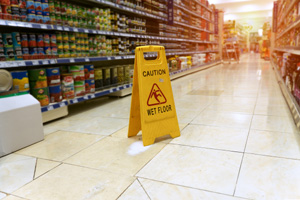
Stores also contest the notice element aggressively. They may produce surveillance footage that shows the hazard appeared only moments before the fall, produce inspection logs showing a check just before the incident, or argue that a wet floor sign was present but you walked past it. Knowing that these defenses are coming is a reason to gather counter-evidence immediately at the scene, before the store’s version of events is the only version documented.
Common Hazards in Retail Slip and Fall Cases
Certain hazards appear repeatedly in shopping environment slip and fall cases in Texas. Liquid spills in the grocery aisles, water pooling beneath produce misters, freshly mopped floors without adequate signage, tracked-in rainwater near store entrances, and spilled merchandise are the most common. In big-box and home improvement stores, improperly stacked merchandise on lower shelves, floor-level display items that extend into walking aisles, and uneven transitions between flooring surfaces create hazards that are entirely the store’s responsibility to address. Parking lot hazards, including potholes, unmarked elevation changes, and accumulated debris near shopping cart corrals, are also covered by the premises liability duty that applies to the entire property the business controls.
Steps to Take After a Slip and Fall at a Store
The evidence available in a slip and fall case depends almost entirely on how quickly it is gathered. Spills are cleaned up. Surveillance footage is overwritten. Witnesses leave. Wet floor signs appear after the fact. The steps you take in the minutes and hours after a fall determine what is preserved and what is lost.
- Photograph the scene before anything is moved or cleaned: Capture the hazard itself, the surrounding area, any signage that was or was not present, the lighting conditions, and your injuries. Take wide shots and close-ups. This is the single most important action you can take at the scene.
- Report the incident to store management and get a written copy of the report: Ask for a copy of whatever the store prepares. Do not sign any form that characterizes the incident or your injuries in terms you have not verified as accurate.
- Get contact information from any witnesses: Bystanders who saw the fall, saw the hazard before you fell, or saw that no wet floor sign was present are valuable. Names and phone numbers are all you need at the scene.
- Seek medical care the same day: A gap in medical treatment is one of the first things an insurer will use to argue your injuries were not serious or were not caused by the fall. Getting evaluated promptly protects both your health and your claim.
- Preserve what you were wearing: Do not wash the shoes or clothing you had on at the time of the fall. Sole condition and footwear type can be relevant to the comparative negligence defense stores frequently assert.
- Contact an attorney before speaking with the store’s insurance adjuster: The store’s insurer will contact you to take a recorded statement. Consulting an attorney first ensures you understand how to handle that conversation without inadvertently weakening your claim.
Frequently Asked Questions About Slip and Fall Accidents in Texas Stores
Does the store have to have known about the spill for me to have a valid slip and fall claim?
Yes, but the notice requirement includes constructive notice, not just actual knowledge. A store can be found liable if the hazard existed long enough that a reasonable inspection program would have discovered it, even if no employee saw it. Courts look at how long the condition was present, how visible it was from employee positions, how frequently the area was inspected, and whether the store’s inspection logs reflect genuine compliance or just paper documentation. A spill that sat unaddressed for 30 minutes in a high-traffic area typically satisfies the notice requirement even without evidence that a specific employee saw it.
Can I still recover if the store says I was partly at fault for not watching where I was walking?
Yes, as long as you are found to be no more than 50 percent responsible. Texas uses modified comparative negligence, which reduces your recovery by your percentage of fault but does not bar recovery entirely unless your fault exceeds 50 percent. Stores routinely argue that injured customers were distracted, not paying attention, or in an area where caution was warranted. Photographs showing no wet floor sign was present, witness testimony about how long the hazard existed, and surveillance footage showing the condition was clearly present are all evidence that counters the argument that customer inattention was the primary cause.
What damages can I recover in a Texas store slip and fall case?
Texas slip and fall victims can recover medical expenses past and future, lost wages and lost earning capacity if the injury affects the ability to work, pain and suffering, and other non-economic losses related to how the injury has affected daily life. The specific categories and amounts depend on the nature and severity of the injury, the quality of the medical documentation, and the strength of the liability evidence. Serious injuries such as hip fractures, knee injuries requiring surgery, and head injuries produce significantly larger damages than minor soft-tissue injuries that resolve quickly.
How long do I have to file a slip and fall lawsuit against a store in Texas?
The Texas statute of limitations for premises liability claims, including slip and fall accidents, is two years from the date of the incident. Missing this deadline permanently bars the right to recover in court, regardless of how clear the store’s negligence may be. The two-year window can feel generous, but surveillance footage is overwritten within days, witness memories fade, and inspection logs may no longer be available after time passes. Starting the process early gives your case the strongest foundation and preserves options that close quickly after the incident.
What if the store claims there was a wet floor sign but I did not see one?
This is one of the most common disputes in slip and fall cases, and it is resolved through evidence rather than competing statements. Surveillance footage from the store often shows whether a sign was present before the fall. Photographs you take immediately at the scene document what was visible at the time. Witnesses who saw the area before and after the fall can provide corroborating testimony. Even when a sign was technically present, its placement, visibility, and adequacy relative to the size and location of the hazard can still support a negligence finding if a reasonably careful store would have done more to warn customers.
Byrd Davis Alden & Henrichson, LLP has represented injured clients throughout Central Texas for over half a century, including victims of slip and fall accidents at grocery stores, big-box retailers, and shopping centers across the Austin area. We know how to build premises liability cases, counter the defenses stores and their insurers raise, and pursue full compensation for the injuries those accidents cause. Our firm has been recognized by U.S. News & World Report as one of the Best Law Firms in the United States.
If you were injured in a slip and fall accident at a Texas store, contact our team for a free case evaluation. We handle premises liability cases on a contingency fee basis, so you pay nothing unless we recover compensation for you. Reach out through our contact page today.