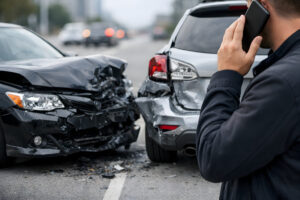
Commercial vehicle accidents turn ordinary days into life-changing emergencies in an instant. When a delivery truck, semi-trailer, work pickup, or company van collides with your vehicle, you have specific legal rights under Texas law: the right to seek compensation from every party responsible, the right to choose your own medical care, the right to decline a recorded statement to the company’s insurer, and the right to demand that the company preserve evidence. Knowing those rights early, before a corporate insurance team sets the tone of your claim, can make a real difference.
At Byrd Davis Alden & Henrichson, LLP, our Austin truck accident attorneys have represented injury victims throughout Central Texas since 1959. This post focuses on your rights as the injured person, step by step, across every kind of commercial vehicle, not only 18-wheelers. If you want a deeper look at how truck claims differ from ordinary car claims, our post on car accident claims versus commercial truck wreck claims in Texas covers that comparison in detail.
Your Core Legal Rights After a Commercial Vehicle Accident
When you are injured by a commercial vehicle, Texas law gives you the right to pursue compensation for your losses. These rights apply whether the vehicle was a delivery van, a company car, a contractor’s work truck, a bus, or a large semi-truck. You may be entitled to seek damages for medical expenses, lost wages, pain and suffering, and property damage. You also have the right to investigate who was responsible and to hold all liable parties accountable, which in a commercial vehicle case often includes not just the driver but the company that employed them, the party that loaded the cargo, and potentially vehicle or parts manufacturers.
Those rights only help if you protect them. Commercial carriers and their insurers tend to move quickly after a crash, and federal regulations, multiple insurance policies, and corporate defense teams create a process that rewards early, careful preparation on your side.
Rights You Have in the First Days After the Crash
The first days after a commercial vehicle crash are often when the most important decisions get made, sometimes before an injured person realizes a decision is being made at all.
The Right to Choose Your Own Medical Care
You are not required to see a doctor chosen by the company or its insurer. Getting prompt, independent medical care protects your health and creates a medical record that documents how your injuries connect to the crash. Gaps in treatment are one of the most common arguments insurers use to reduce the value of a claim.
The Right to Decline a Recorded Statement
The commercial carrier’s adjuster may call within days and ask for a recorded statement or a broad medical authorization. You generally have no obligation to give the other side’s insurer a recorded statement. Anything you say can be used to argue that you were partly at fault, and under Texas proportionate responsibility rules, your recovery can be reduced by your percentage of fault or barred entirely if you are found more than 50 percent responsible.
The Right to Demand Evidence Preservation
Commercial vehicles generate records that ordinary cars do not: electronic logging device data, engine control module data, dashcam footage, dispatch messages, and maintenance logs. Some of this information can be overwritten on short cycles. A lawyer can send the company a preservation letter (often called a spoliation letter) that puts it on notice to keep that evidence.
The Right to Refuse a Quick Settlement
An early offer may look generous before you know the full extent of your injuries, but signing a release typically ends your claim permanently. You have the right to wait until your medical picture is clear enough to value your losses accurately.
Why Commercial Vehicle Accidents Are Different
The physical scale of commercial vehicles creates injury potential that passenger car accidents rarely match. According to the National Highway Traffic Safety Administration, 5,472 people were killed in traffic crashes involving large trucks in 2023, and 70 percent of those killed were occupants of other vehicles rather than the truck itself. The size and weight disparity between commercial vehicles and passenger cars means that injuries in these crashes are more likely to be severe, lasting, and life-altering.
Common serious injuries in commercial vehicle crashes include:
- Traumatic brain injuries: Severe head trauma that may require long-term rehabilitation and can produce permanent cognitive changes
- Spinal cord damage: Paralysis or permanent mobility limitations that affect every aspect of daily life
- Multiple bone fractures: Complex breaks requiring surgical intervention and extended recovery periods
- Internal organ damage: Life-threatening injuries from blunt force trauma that may not be immediately apparent after the crash
These injuries often require prompt legal action to pursue compensation for both present and future medical care, income replacement, and quality-of-life losses. Our post on what damages you can recover after being hit by a commercial truck in Texas explains each category in more depth.
The Corporate Defense Advantage
Commercial vehicle accidents also differ because you are typically dealing with a well-funded company and its insurer. Trucking companies and their insurers often send rapid-response investigators to accident scenes quickly to gather evidence. They have legal counsel on retainer who understand how to minimize liability and reduce settlement values. Without equally prepared representation, injury victims sometimes accept settlements that do not come close to covering the full cost of their losses.
What Counts as a Commercial Vehicle?
There is no single definition. For commercial driver’s license purposes, Texas generally treats a vehicle as a commercial motor vehicle if it has a gross vehicle weight rating of 26,001 pounds or more, is designed to carry 16 or more passengers including the driver, or carries hazardous materials that require placards. Federal safety rules for interstate carriers reach further, applying to many vehicles with a gross vehicle weight rating of 10,001 pounds or more.
For an injury claim, the label matters less than how the vehicle was being used. The obvious candidates are 18-wheelers, semi-trucks, and tanker trucks, but the same employer liability principles can apply to delivery vans, plumbers’ and electricians’ work trucks, sales reps’ company cars, shuttle buses, and any vehicle driven for a business purpose. Our company vehicle crash attorneys handle claims involving these smaller business vehicles as well as large trucks.
Federal Safety Regulations That Apply to Commercial Carriers
The Federal Motor Carrier Safety Administration (FMCSA) administers a comprehensive set of rules governing interstate commercial carriers. Hours-of-service regulations limit how long a commercial driver can operate a vehicle before mandatory rest is required. Maintenance regulations require regular inspection and repair of critical systems including brakes, tires, steering, and lighting. Driver qualification standards set minimum requirements for licensing, medical fitness, and driving history. Drug and alcohol testing programs mandate pre-employment, random, post-accident, and reasonable-suspicion testing.
When a carrier or driver violates any of these regulations and a crash results, that violation can support a negligence claim. Electronic logging device (ELD) records document driver hours and can reveal whether a driver exceeded hours-of-service limits before a crash. For a closer look at these rules, see our post on how federal trucking regulations protect Austin drivers.
Insurance Minimums Are Often Higher
Federal rules also require for-hire interstate carriers hauling general, non-hazardous freight in vehicles of 10,001 pounds or more to carry at least $750,000 in public liability coverage, with higher minimums for many hazardous materials loads. A typical personal auto policy carries far lower limits. Identifying every applicable policy, including the carrier’s policy, any excess or umbrella coverage, and the coverage of other liable parties, is a key part of protecting your right to a full recovery.
Who Can Be Held Liable After a Commercial Vehicle Crash
One of the defining characteristics of commercial vehicle cases is that multiple parties may share responsibility for a crash, and each may be covered by a different insurance policy. Identifying every potentially liable party is critical to building a complete claim.
The Driver
A commercial driver can be personally liable for negligent operation: distracted driving, drowsy driving, following too closely, improper lane changes, or violations of traffic law. Logbook and ELD data showing hours-of-service violations are particularly significant in cases involving driver fatigue.
The Trucking or Delivery Company
Under the legal principle of respondeat superior, an employer can be liable for the negligent acts of an employee committed within the scope of employment. This means the company can be responsible for your damages even when the driver, rather than company management, made the critical error. Companies can also be independently liable for negligent hiring when they placed an unqualified or unsafe driver in a commercial vehicle, for inadequate training, or for scheduling pressures that push drivers to violate safety rules. For commercial truck crash cases in particular, the carrier’s compliance history and safety rating are important parts of the evidence picture.
The Cargo Loading Company
FMCSA regulations impose strict requirements on how cargo must be secured for transport. When loads shift in transit, fall from a vehicle, or create handling instability that contributes to a crash, the party responsible for loading the cargo may share liability alongside the driver and the carrier. Manifest records, loading documentation, and the physical condition of cargo restraints at the scene are all evidence worth preserving quickly.
Vehicle or Parts Manufacturers
When a mechanical failure contributed to the crash, whether a tire blowout, brake failure, steering defect, or other component issue, the manufacturer of the defective part may bear product liability for the accident. Product liability claims can run alongside negligence claims and can expand both the pool of potentially liable parties and the insurance coverage available.
When the Commercial Vehicle Belongs to a Government Entity
City buses, garbage trucks, utility trucks, and road maintenance vehicles are commercial vehicles too, but claims against government entities follow different rules. The Texas Tort Claims Act allows certain claims arising from a government employee’s use of a motor vehicle, but it caps damages and requires formal notice of the claim. Under Section 101.101 of the Texas Civil Practice and Remedies Code, the government unit generally must receive notice within six months of the incident, and many city charters set even shorter deadlines. Missing a notice deadline can end an otherwise valid claim, so it is important to act quickly. Our post on whether you can sue the government for negligence in Texas explains these rules further.
Common Types of Commercial Vehicle Accidents
Several accident patterns occur more frequently with large commercial vehicles than with passenger cars, and each carries its own liability dynamics.
Jackknife accidents occur when a semi-truck’s trailer swings out to form an acute angle with the cab, typically during hard braking on slick surfaces or as a result of brake problems. A jackknifing trailer can sweep across multiple lanes and strike several vehicles at once.
Wide-turn crashes happen when truck drivers swing left before turning right to accommodate the vehicle’s turning radius, creating a gap that can trap motorcycles, cyclists, or passenger vehicles traveling alongside the truck. These accidents frequently occur at intersections.
Hazardous materials accidents involve commercial vehicles transporting flammable, toxic, corrosive, or otherwise dangerous cargo. When these vehicles crash, the hazards extend beyond the collision itself to the materials released, which can affect emergency responders, bystanders, and nearby residents, and they add regulatory questions about hazmat transport compliance.
Proving Liability in Commercial Vehicle Cases
Establishing liability in a commercial vehicle accident requires thorough investigation and documentation across multiple evidence sources. Our team gathers police reports, witness statements, electronic logging device data, maintenance records, driver employment files, and cargo loading documentation. Federal regulations governing commercial vehicles create additional ways to prove negligence, such as hours-of-service violations or poorly maintained equipment shown through maintenance logs and inspection records.
Acting quickly to preserve evidence is essential. Companies have internal policies governing how long records are retained, and some data, including onboard diagnostic records and dashcam footage, may be automatically overwritten. The earlier a preservation letter goes out, the more evidence is likely to survive.
Time Limits for Filing Commercial Vehicle Injury Claims
Under Section 16.003 of the Texas Civil Practice and Remedies Code, most personal injury lawsuits must be filed within two years from the date the claim accrues, which in a crash case is usually the accident date. Wrongful death claims generally run two years from the date of death. Missing these deadlines typically results in the permanent loss of your right to compensation, regardless of how strong your case might be. As noted above, claims involving government vehicles carry much earlier notice requirements, and interstate carriers can raise jurisdictional questions that affect where a case is filed.
Starting early gives your legal team time to investigate thoroughly, preserve evidence, engage accident reconstruction professionals whose testimony may be important, and build the strongest possible case before any deadlines approach.
Frequently Asked Questions About Commercial Vehicle Accidents
Can I sue the trucking company directly, or only the driver?
You can often pursue both the driver and the company. Under respondeat superior, a company can be liable for the negligent acts of its employee drivers during the course of employment. You may also have independent claims against the company for negligent hiring, inadequate training, or violations of FMCSA safety regulations. Claims against the company matter because commercial carriers typically carry significantly higher insurance limits than individual drivers.
What if the truck driver was classified as an independent contractor?
Independent contractor classification does not automatically shield a company from liability. Courts look at the degree of control the company exercised over how the work was performed, not just the label in the contract, and federally regulated motor carriers can have their own responsibilities for vehicles operated under their authority. An attorney can investigate the actual working relationship to determine whether that classification holds up.
What damages can I recover after a commercial vehicle crash in Texas?
In Texas, you may be able to recover past and future medical expenses, lost wages and reduced earning capacity, pain and suffering, mental anguish, physical impairment, disfigurement, and property damage. In cases involving gross negligence, exemplary damages may also be available, subject to statutory limits. Because commercial vehicle crashes often cause serious injuries, accurately calculating future medical costs and lost earning potential is a critical part of a complete claim.
Should I speak to the trucking company’s insurance adjuster without a lawyer?
It is usually wise to talk with a lawyer first. The company’s insurer may request a recorded statement, ask for a broad medical authorization, or make a quick settlement offer before you understand the full scope of your injuries. You are generally not required to give the other side’s insurer a recorded statement, and getting advice before that conversation can help protect your claim.
What if I was hit by a city bus or other government vehicle?
Claims involving government vehicles fall under the Texas Tort Claims Act, which limits damages and requires formal notice of the claim. State law generally requires notice within six months, and many city charters set shorter deadlines. Because missing that notice can bar the claim, it is important to speak with a lawyer as soon as possible after the crash.
How is a commercial vehicle accident claim different from a regular car accident claim?
Commercial vehicle claims can involve federal FMCSA regulations, multiple potentially liable parties, higher insurance limits, and well-resourced defense teams. The evidence is also more technical: electronic logging devices, engine data, driver qualification files, and maintenance records play roles that do not exist in most car accident cases. These cases usually benefit from early investigation and prompt evidence preservation letters.
The attorneys at Byrd Davis Alden & Henrichson, LLP have recovered over $100 million for our clients. Past results do not guarantee a similar outcome in any future case, and every claim depends on its own facts. We handle injury cases on a contingency fee basis, meaning you pay no attorney’s fees unless we recover compensation for you; how case costs and expenses are handled is explained in our written fee agreement. Our trial lawyers prepare every case as though it may go to court, and we are willing to take cases to trial when a fair settlement cannot be reached.
If you or someone you care about was injured by a commercial vehicle in or around Austin, we can review what happened, identify the responsible parties, and explain your options. Reach out through our contact page to get started.